EYFS Continuous Provision Ideas for Summer Term
Summer term in EYFS is my favourite. The children are more confident, the outdoor space comes alive, and there’s a natural energy that makes everything feel possible. After a year of building relationships, routines, and skills, summer is when you see it all come together.
Here are the continuous provision setups I’ve used across multiple settings, all linked to curriculum areas and all tried and tested with real children. No fluff. Just ideas you can actually use.
Outdoor Provision: Make It Your Main Classroom
If your setting has any kind of outdoor space, summer term is when it should be doing the heavy lifting. Under the EYFS framework, outdoor play should be part of continuous provision, with children having genuine free-flow access between indoors and out.
The best outdoor provision isn’t a replica of the indoor classroom with a roof off. It’s an environment that offers things the indoor space can’t: space to move, natural materials, sensory experiences, mess, and volume.
A Mud Kitchen That Teaches
Most EYFS settings have a mud kitchen these days. The difference between a good one and a great one is intentional resourcing.
- Add real recipe cards (laminated, with pictures) that include quantities: “2 cups of mud, 3 spoons of water, 1 handful of petals.” This brings in early maths, reading, and following instructions without the children realising they’re learning.
- Include measuring tools that actually measure: cups with ml markings, kitchen scales, measuring spoons. The mathematical language that emerges is remarkable.
- Rotate ingredients seasonally. Summer means petals, cut grass, herbs from the garden (lavender is brilliant), seed heads, and small pebbles. Each new ingredient provokes different language and exploration.
Curriculum links: Mathematics (measures, counting, comparison), Communication and Language (descriptive vocabulary, following instructions), Physical Development (fine motor, pouring, mixing).
A Digging Zone
Give children a dedicated patch of earth and proper tools, not the tiny plastic ones that break in five minutes, but child-sized metal trowels and buckets. What happens next is almost always rich learning.
In summer, a digging zone becomes a minibeast investigation site. Add magnifying glasses, bug pots, and simple identification charts, and children will spend an entire session classifying, comparing, and talking about what they’ve found.
Curriculum links: Understanding the World (living things, habitats, observation), Communication and Language (describing, questioning, explaining), Personal, Social and Emotional Development (collaborative play, sharing space).
Water Play: Beyond the Water Tray
The standard water tray with a few jugs is fine, but summer gives you the chance to do so much more.
Guttering and Pipe Runs
Fix sections of guttering and plastic pipe at different heights on a fence or outdoor frame. Add funnels, connectors, and containers at the bottom. Children experiment with flow, gravity, volume, and problem-solving. They work together to hold pieces in place, redirect water, and stop leaks.
This is one of the richest learning provocations I’ve ever used. The language alone is worth it: “faster,” “slower,” “full,” “empty,” “blocked,” “it’s going the wrong way.” Mathematical and scientific thinking happening naturally, without a worksheet in sight.
Capacity Station
Set up a collection of different-sized containers alongside the water tray: bottles, jugs, cups, scoops. Add laminated challenge cards: “Which holds the most?” “Can you find two that hold the same?” “How many small cups fill the big bottle?”
Simple, cheap, and directly addresses the Mathematics ELG for numerical patterns.
Frozen Treasures
The night before, freeze small world figures, natural objects, or letters into blocks of ice using old food containers. In the morning, put them out with pipettes of warm water, small hammers, and magnifying glasses. Children work to free the objects, developing fine motor skills while exploring melting, temperature, and states of matter.
Children find this genuinely thrilling, even children who rarely engage with more structured activities. It works every single time.
Curriculum links: Understanding the World (properties of materials, change), Physical Development (fine motor control), Mathematics (capacity, comparison), Communication and Language (prediction, description).
Minibeasts: A Ready-Made Topic
Minibeasts are summer term gold for EYFS. Children are naturally fascinated, the outdoor environment provides everything you need, and the curriculum connections are endless.
Setting Up a Minibeast Investigation Area
- Bug hotel: Build one with the children using pallets, bamboo canes, straw, pinecones, and broken pots. The building process teaches as much as the observing.
- Observation station: A table near planting areas with magnifying glasses, bug viewers, clipboards, and simple ID charts. Children draw, label, and record what they find.
- Class wormery: A clear-sided container with layers of soil and sand. Feed it vegetable scraps and watch the worms work. It’s revolting and fascinating in equal measure, which makes it perfect for four-year-olds.
Books to Support the Provision
Stock the reading area and outdoor book basket with titles like The Very Hungry Caterpillar, Superworm, Mad About Minibeasts, Aaaarrgghh! Spider!, and non-fiction titles with real photographs. The combination of story books and information texts supports both imagination and scientific enquiry.
Curriculum links: Understanding the World (characteristics of living things, habitats, life cycles), Literacy (non-fiction texts, vocabulary), Expressive Arts and Design (observational drawing), Communication and Language (questioning, describing).
Growing and Planting
You don’t need a garden to grow things. Window boxes, old wellies, and even cut-off milk cartons work perfectly well.
What to Plant in Summer Term
- Sunflowers are the classic for a reason. They grow fast enough that children can see weekly progress, and you get meaningful measuring and comparison activities.
- Cress germinates in days. Grow it on damp cotton wool in egg boxes for a quick win.
- Runner beans in clear plastic bags taped to windows let children see root growth. Genuinely magical for small children.
- Herbs like basil, mint, and coriander add sensory experiences. Crushing a mint leaf and smelling it generates more language than you’d expect.
Making Growth Meaningful
Don’t just plant and water. Build the learning in:
- Measure and record growth weekly using non-standard measures (“My sunflower is 4 cubes tall”).
- Draw observational pictures at different stages. Display these sequentially to show change over time.
- Create a simple class diary: “Day 1: We planted our seeds. Day 5: We can see a shoot.”
- Introduce vocabulary deliberately: root, stem, leaf, petal, soil, seed, germinate, grow.
Curriculum links: Understanding the World (growth, change, living things), Mathematics (measuring, comparing, recording), Literacy (mark-making, labelling, diary writing), Communication and Language (new vocabulary, explaining observations).
Creative Provision: Summer Enhancements
Natural Printing
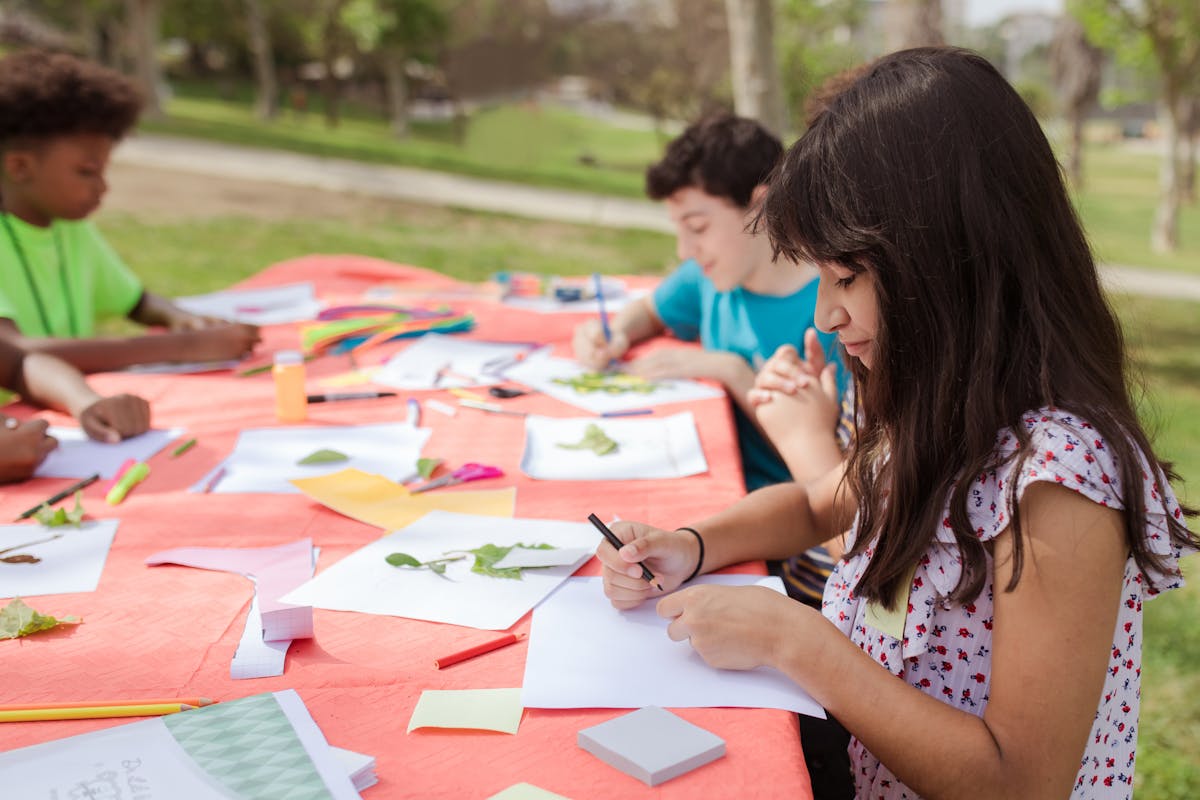
Collect leaves, ferns, seed heads, and flowers. Dip them in paint and press onto paper. It sounds simple, and it is. But the conversations about pattern, symmetry, texture, and nature that come from it are rich.
Land Art
Inspired by Andy Goldsworthy, give children a collection of natural materials, sticks, stones, petals, leaves, and invite them to create patterns and pictures on the ground. Photograph the results. This is a brilliant provocation for mathematical thinking (pattern, symmetry, sorting) disguised as art.
Outdoor Mark-Making
Swap the indoor writing table for an outdoor one. Add clipboards, chalks for the ground, water and paintbrushes for mark-making on walls (it dries and disappears, which children love), and sticks for writing in sand or soil. Writing feels different outdoors. Less pressured. More experimental. For reluctant writers, this can be transformative.
Making It Work With Limited Resources
I know not every setting has a sprawling outdoor area, a budget for new equipment, or the luxury of time to set up elaborate provocations. I’ve taught in settings with a small concrete yard and almost no budget. Here’s what I’ve learned:
- Natural materials are free. Sticks, stones, leaves, pinecones, feathers, shells. Collect them. Store them in baskets. They’re some of the most versatile resources you’ll ever use.
- Parents are a goldmine. Ask for old pots and pans for the mud kitchen, spare wellies for planting, old baking trays, and empty containers. Most families are happy to contribute.
- Rotate, don’t replace. You don’t need everything out every day. Swap provision weekly. A water play focus one week, a construction focus the next. Fewer options, better quality engagement.
- Photograph what works. Take a quick photo of any setup that generates great learning. Build your own bank of ideas that you know work in your specific space.
Ready-Made Summer Provision Resources
All of these ideas are things I’ve used in my own classrooms. At ClickTeach, I’m turning them into ready-to-use resource packs: challenge cards, provision maps, vocabulary lists, observation prompts, and enhancement ideas, all mapped to specific curriculum areas and differentiated for different developmental stages.
If you’d like access to those resources when they’re ready, along with the Sunday Saver weekly planning pack, register your interest here. I’ll let you know as soon as we launch.
In the meantime, get outside. Summer term is short. Make the most of it.